A small kids bedroom doesn’t have to feel small. The trick is treating every piece of furniture as if it has a job to do, and being honest about the pieces that don’t. Get the bed, the storage and the work surface right, and a 9m² room can feel calm, ordered and genuinely cosy.
Here are the ideas we keep coming back to when we’re helping families furnish compact bedrooms in South African apartments and family homes.
Start with the Bed: It’s the biggest decision
In a small room, the bed is the piece that determines everything else. Choose well and the rest falls into place. Choose poorly and you’ll be fighting the room for years.
A few approaches that work in tight spaces:
A single with under-bed drawers. The simplest space-saver. A standard single is just 92cm wide and runs along one wall, leaving the rest of the floor genuinely usable. Drawers under the mattress base swallow toys, out-of-season clothes and the bulky things that would otherwise need a separate chest.
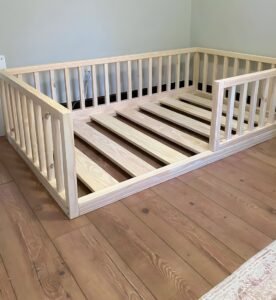
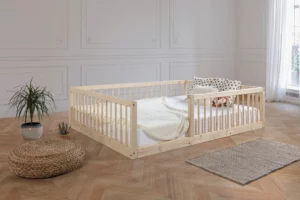
A house bed against a corner. A wooden house bed tucked into a corner creates a defined sleeping nook without taking up more space than a standard bed. Children love the enclosed feel; parents love that bedtime suddenly becomes a destination.
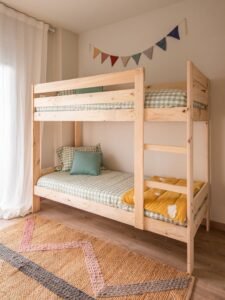
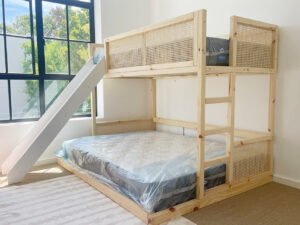
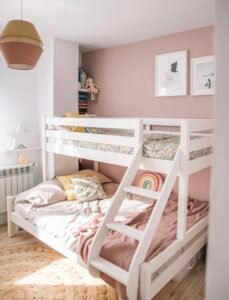
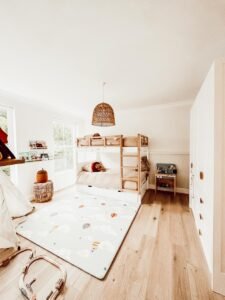
A bunk bed for two children. If the room is shared, a bunk bed effectively halves the floor footprint of two beds. Done well, the space under the bottom bunk can also house drawers or low shelves.
A daybed with a trundle. Brilliant if the room doubles as a guest room or a sibling’s occasional sleepover spot. The daybed feels like a sofa during the day and pulls out into two single beds at night.
What to avoid: oversized headboards in small rooms, sleigh beds with curved bases that eat floor space, and any bed wider than a three-quarter unless the room is genuinely 10m² or more.
Use the vertical space
Most small bedrooms are taller than they are wide. The walls are your biggest under-used asset.
A few principles:
- Take shelving close to the ceiling. A 2m-high bookshelf holds dramatically more than a 1.4m one, and reaches into space you weren’t using anyway.
- Hang things off walls instead of putting them on the floor. A wall-mounted reading light replaces a bedside lamp on a table. Hooks for school bags replace a chest in the corner.
- Use the wall above the bed. A long, shallow shelf above the bed holds books, framed photos and bedtime essentials without competing for floor space.
- Consider a wall-mounted desk. A fold-down or wall-fixed desk gives the child a real work surface without a permanent piece of furniture in the middle of the room.
Our range of shelves and storage is designed around this principle: most pieces are tall and narrow, optimised for vertical use of small rooms.
One piece, more than one job
The pieces that earn their place in a small room are the ones that do more than one thing.
Storage bed. A bed with built-in drawers underneath is two pieces of furniture in one.
Toy box as bench. A flat-topped toy box becomes a window seat or a reading bench when it’s not being rummaged through.
Bookshelf as room divider. In a long, narrow room, particularly one shared between two children, a tall open-back bookshelf can create two distinct zones without building a wall.
Bedside table as small desk. A slightly wider bedside table doubles as a homework surface for younger children who don’t yet need a full desk.
Headboard with storage. A headboard with built-in shelves removes the need for a bedside table altogether.
The discipline is to ask, of every piece in the room: is this earning its space?
Storage rules for small rooms
Storage in a small bedroom isn’t about adding more containers, it’s about being ruthless with what’s in the room in the first place. A few rules we lean on:
- Closed storage hides clutter; open storage rewards order. Use closed storage for the messy stuff and open shelves for the things you want to see.
- Sort by frequency of use. Daily-use items at child height. Weekly items higher up. Seasonal or rarely-used items in deep storage (under the bed, top of a cupboard).
- One container per category. A box for Lego, a box for soft toys, a box for craft. When a box overflows, something has to leave the box, not a new box added.
- Label everything for younger children. Picture labels for under-fives, word labels for older. The goal is independent tidy-up, not parent-led sorting.
For more on the philosophy here, our piece on why storage simplicity matters goes deeper.
A small desk that actually gets used
The instinct in small rooms is to skip the desk entirely. Don’t, but be realistic about the size.
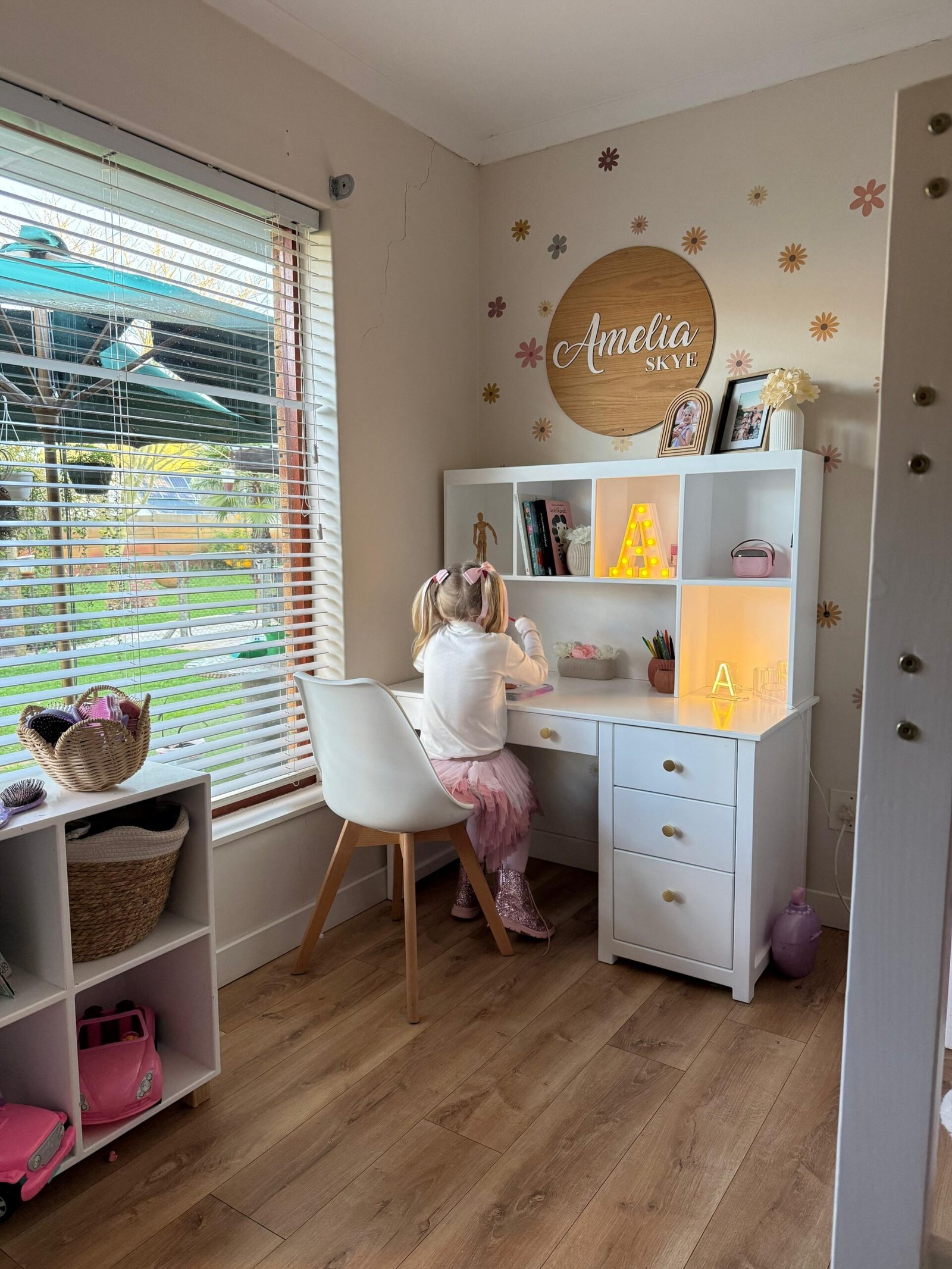
A child-scale desk or table at 60–80cm wide gives a primary-school child everything they need for homework, drawing and quiet projects. Pair it with a single chair (skip the chair-set) and place it where the natural light falls, usually facing a window or perpendicular to one.
What to skip:
- Bookshelves attached to the desk (they make the unit dominate the room)
- Storage stacked above the work surface (it puts pressure on the child to keep the desk tidy at all times)
- A desk wider than 100cm in a small room (you don’t need it)
Lighting that doesn’t take up space
A few lighting moves that buy you floor space:
- Wall-mounted bedside lights instead of a lamp on a table
- A pendant or wall sconce at the work area instead of a desk lamp
- Plug-in wall lights for renters who can’t drill into walls
- Warm-toned LED bulbs. They make a small room feel more inviting than cool white
Colour and visual quietness
This isn’t strictly furniture, but it’s worth saying: small rooms feel bigger when the visual noise is low. A muted, consistent palette across walls, bedding and curtains makes the room feel more spacious. Bright accent colours work best on smaller pieces, a cushion, a rug, a single bookshelf, rather than on the dominant surfaces.
The piece our customers feel most strongly about: clear floor space. Even a small room feels generous if you can see the floor from the doorway.
Putting it all together: a sample 9m² layout
For a 3m × 3m room, a reliable layout:
- Single bed along one wall, head against a corner
- Tall narrow bookshelf at the foot of the bed, facing the door
- Small desk under the window
- Toy storage along the wall opposite the bed, low enough for the child to reach
- One pendant light, one bedside wall light, one desk lamp
- A rug that’s smaller than the floor, leaving a clear border
That setup houses one child comfortably from age four through to mid-primary school, with minimal rearranging required as they grow.
Browse pieces sized for small rooms
Have a look at our house beds, our shelves and storage range, or our full kids beds collection, every piece is made to order in our Cape Town workshop, and many can be sized to fit unusual room dimensions.