A Montessori bedroom is not a look; it is a philosophy made physical. The goal is a room where the child can manage most of what they need independently: getting in and out of bed, choosing their own clothes, finding and returning their toys. Done well, it reduces morning frustration, encourages tidy habits and gives a young child a genuine sense of ownership over their space.
You do not need to buy everything at once or follow a strict rulebook. But there are a few principles worth understanding before you start, and some furniture decisions that support them better than others.
What makes a bedroom Montessori?
The short version: everything is scaled to the child, and everything is accessible without adult help. The child-height principle applies to the bed, the storage, the clothing rail and the mirror. If the child needs to ask a parent to reach something, it is not truly theirs.
The secondary principle is limited choice. Montessori classrooms famously rotate materials: only a small selection is out at any one time, and everything has a defined place. This reduces the overwhelm of too much choice and makes tidying up a realistic expectation even for toddlers.
Start with the floor bed
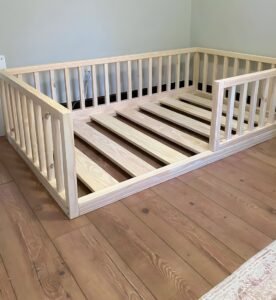
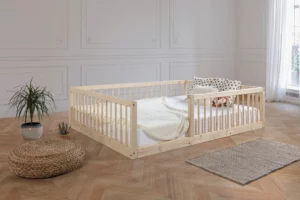
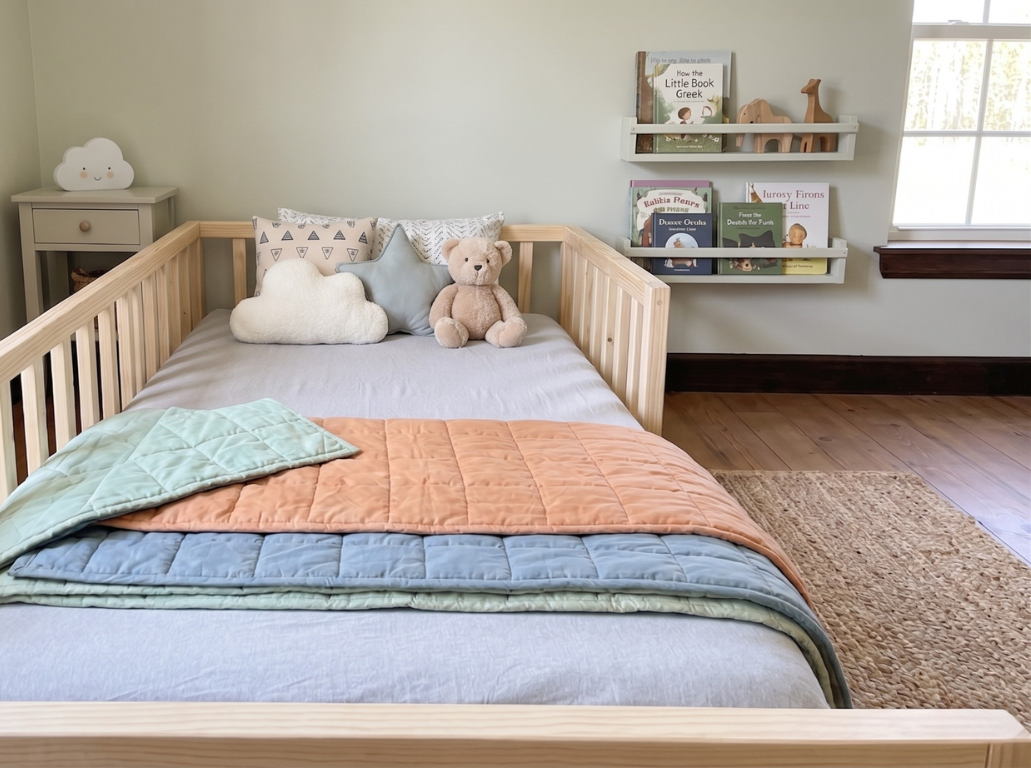
The floor bed is the most visible element of a Montessori bedroom, and usually the first decision. A low bed, whether a simple mattress on a platform or a house-frame design, gives the child full independence over their sleep: in and out on their terms, without calling for a parent.
Our piece on Montessori floor bed pros and cons covers the full picture, including the trade-offs. The short version: it works very well for most children between 18 months and 5 years, particularly for confident sleepers in a well-organised room.
For placement: position the bed against one or two walls. This gives the child a sense of security and limits the directions they can roll out. Leave clear floor space on at least one side for easy access. If you are using a house-frame bed at floor level, the frame itself creates the contained sleeping nook; place it against a wall for a built-in feel.
Low, accessible storage
Once the bed is placed, storage is the next priority. In a conventional child’s room, most storage is adult-height: wardrobes, high shelves, top-of-the-cupboard toy bins. In a Montessori room, the rule is simple: if the child cannot reach it without help, it should not be in their daily rotation.
Low toy boxes, open cubbies and shallow drawers all work well. A low cube-style bookcase with a few toy baskets on the bottom shelf and books spine-out on the upper shelves is one of the most practical combinations we see.
For clothes: a low hanging rail at shoulder height for the child, with a small basket of folded bottoms below it, lets a three-year-old choose and change their own outfit. One or two hooks at child height for bags and jackets complete the picture.
Open shelving and toy rotation
Closed toy boxes present two problems in a Montessori setup. First, the child cannot see what is inside without tipping the box over. Second, everything goes in together, which makes tidy-up feel enormous. Open shelving with defined spots for each item is far more effective.
The rotation principle: keep only a small selection of toys and activities accessible at any one time. Store the rest out of sight and swap them every week or two. This keeps the room calm, makes each toy feel fresh when it reappears, and makes returning things to their spot a manageable task.
In practice, five to eight items on open shelves is enough for most toddlers. Each has a fixed spot. Baskets and trays help contain loose pieces. Books can be displayed spine-out on a low rail shelf so covers are visible.
Mirrors, natural light and materials
A full-length mirror at floor level is a classic Montessori addition. Toddlers are deeply interested in themselves, and a mirror at their height encourages self-dressing, body awareness and language development. Mount it securely, flat against the wall, and ensure the edges are framed or covered.
Natural light matters more in a Montessori room than in a standard nursery because the child spends time on the floor. Low windows that let in morning light, or sheer curtains that allow soft diffused light, make the floor-level space feel bright and welcoming rather than dim.
For materials: solid wood furniture, natural fibre rugs and cotton bedding all fit the Montessori aesthetic and are practical choices in South African homes. Solid pine furniture holds up to daily use, is repairable and does not off-gas the way some composite boards do.
What we make that works well in a Montessori setup
From our workshop, the pieces that suit a Montessori bedroom best are:
- House bed frames at floor level: a classic combination of Montessori independence and a defined sleeping space. We build them in single and three-quarter sizes, in plain or scalloped styles.
- Low bookcase and cube units: our bookcase range includes shallow cubbies and low-profile units that work well for toy rotation and book display.
- Toy boxes and storage units: several of our storage pieces take standard-size baskets on open shelves, which is the most practical floor-level toy organisation we know of.
If you are putting a room together from scratch or rethinking an existing space, feel free to get in touch. We are happy to talk through what would work best for your room size and your child’s age.