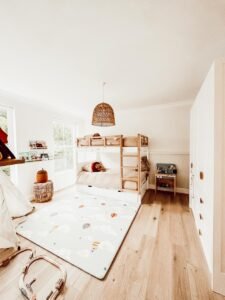
The Montessori floor bed has gone from niche-parenting curiosity to a mainstream option in South African children’s bedrooms over the past few years. The premise is simple: a low-profile bed at ground level, with no rails or barriers, that the child can climb into and out of independently. The idea is grounded in Maria Montessori’s wider philosophy of building autonomy from a young age.
But like any parenting choice, it’s not for everyone, and the version that works for one family can fail another. Here’s a balanced look at the floor bed: the genuine benefits, the real trade-offs, and how to know if it suits your child.
What exactly is a Montessori floor bed?
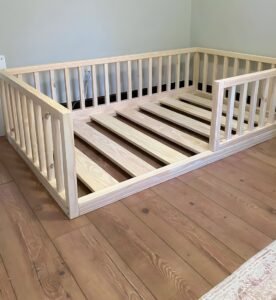
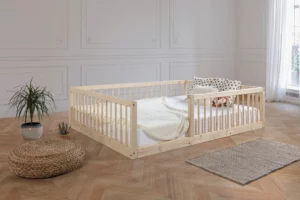
A floor bed is a mattress that sits at: or very close to, floor level, with a low surround that lets the child climb in and out without an adult. Some are simply a mattress on a low platform; others are wooden frames a few centimetres off the ground, sometimes shaped like a house, a teepee or a low rectangle.
The defining features:
- Low to the ground, usually 5–20cm of clearance
- No safety rails that confine the child
- Open access from at least one side, often more
- Sized so the child can see the rest of the room from the mattress
In our workshop we make floor beds in single and three-quarter, plain or in our house bed frames, all designed to integrate calmly into the room.
The Pros: The Case for a Floor Bed
Independence. This is the big one. Toddlers can climb in for a nap or in the morning without waiting for a parent, and they can climb out without calling for help. For many children, this dramatically reduces bedtime resistance and early-morning frustration.
Easier transitions out of the cot. The drop from a cot mattress to the floor is huge: a regular bed feels strange and high after months of being enclosed. A floor bed bridges that gap. Our piece on moving from a cot to a bed explores the timing in more detail.
Lower fall height. A floor bed is, by definition, much closer to the floor. If a child rolls out in their sleep, the fall is shorter and softer than from a standard bed.
Visually calmer rooms. Low-profile beds make small bedrooms feel bigger. They free up the visual line and make the space feel airier, particularly noticeable in compact apartments.
They work with house bed frames. A house-frame bed at floor level gives a child a cosy, defined sleeping nook while still meeting Montessori principles. Many of our house bed designs can be configured at floor height.
The Cons: What to Consider Before You Commit
Sleep wandering. A child on a floor bed isn’t physically contained. For some toddlers this is exciting in the worst possible way: they get out and roam at 2am, or appear at your bedside before sunrise. This usually settles, but the first few weeks can be tough.
Room-proofing becomes critical. If the child can leave the bed unsupervised, every electrical socket, every drawer, every cord, every loose item in the room needs to be safe. This is more rigorous than the usual toddler-proofing.
Not ideal for poor sleepers. If your child wakes frequently and needs adult intervention to fall back asleep, a floor bed can make the problem worse by removing the small “barrier” of a railed bed. Some families do better with a low-railed regular bed during this phase, then move to a floor bed later.
Cold floors in winter. South African winters in Joburg or the Highveld can be cold at floor level. A good rug, an underfloor liner, or a slightly raised platform takes care of this.
Less flexible for guests and sleepovers. A standard bed accepts a top-and-tail friend easily. A floor bed setup, particularly a house-bed style frame, is a one-child piece of furniture.
What age does a floor bed suit?
The Montessori philosophy suggests floor beds from around 5–6 months. In practice, most South African families introduce them between 18 months and 3 years, as a transition out of the cot.
Reasonable age guidelines:
- Under 12 months: Most paediatric advice favours a cot at this age. Consult your paediatrician before transitioning.
- 18 months to 3 years: The sweet spot. Children at this age genuinely benefit from independence.
- 3 to 5 years: Floor beds still work well, especially in a house-frame design.
- 5+ years: Most children prefer a standard-height bed by this point; a floor bed can feel babyish. Time to size up.
If you want a floor bed that grows with your child, look for a design that can be raised onto a standard frame later. We can adapt several of our classic kids beds this way, send us a message and we’ll talk through the options.
How to set up a floor bed well
A few practical points that make the difference between a calm setup and a frustrating one:
- Place the bed against at least one wall. Most children prefer the security of a wall on one side, especially in the first months.
- Keep the floor immediately around the bed clear. No books, no soft toys, no edges to roll onto.
- Use a slim, supportive mattress. A 12–15cm mattress is plenty: taller mattresses defeat the “low” purpose.
- Add a soft rug rather than carpet for warmth and a gentle landing zone.
- Avoid heavy bedding under age 2. A sleeping bag is safer than a duvet for younger toddlers.
A Quiet Alternative: A House Bed at Floor Level
If the pure Montessori floor mattress feels too open, a house-frame bed at floor level gives you most of the benefit with a touch more containment. The frame creates a defined “room within a room” that toddlers love, but the entry and exit are still independent.
This is the setup we see most often in South African homes, a beautifully made wooden house bed that grows into a primary-school bedroom without ever feeling babyish.
So, is a floor bed right for you?
The honest answer: it depends. Floor beds work brilliantly for confident, calm sleepers in a well-organised room. They struggle in homes where the child is a poor sleeper, or where the room can’t be fully toddler-proofed.
If you’re on the fence, try it for two weeks. Move the mattress to the floor, see how your child responds, and decide from there. If it works, we’d be glad to make the wooden frame to match.
Have a look at our house bed collection or browse all our kids beds, and don’t hesitate to get in touch if you’d like help choosing.