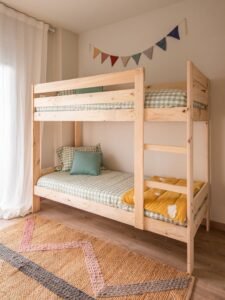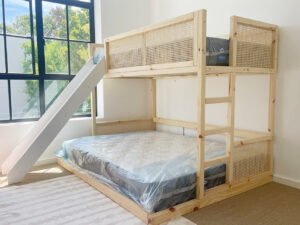
Bunk beds are one of the most efficient ways to share a kids’ room. They free up floor space, they give each child a defined sleeping area, and they make sleepovers genuinely fun. But they also come with a list of safety questions every parent asks before clicking buy.
How young is too young for the top bunk? What’s a safe guardrail height? Should the ladder be vertical or angled? Here’s a straightforward guide based on international safety standards and what we’ve learned from years of building bunks for South African families.
At what age is the top bunk safe?
The consistent international guideline, from the American Academy of Pediatrics, the UK’s RoSPA, and Australia’s product safety authority, is six years old as the minimum age for the top bunk.
The reasoning is simple. Children under six don’t have the spatial awareness to manage a 1.5m drop reliably, particularly when half-asleep. They’re also more likely to climb on guardrails and over the edges in ways an older child wouldn’t.
A reasonable age framework:
- Under 6: Lower bunk only. The top bunk is unsafe regardless of how careful or steady the child seems.
- 6 to 9: Top bunk is fine for confident sleepers. Some children at this age still prefer the bottom bunk, that’s a perfectly good signal to follow.
- 9 and up: No restriction. Sleepover top-bunk swapping is normal at this age.
If you have two children of different ages, the younger child takes the lower bunk by default. If a younger sibling really wants the top bunk, wait until their sixth birthday at the earliest, and even then, use your judgement based on how the child handles heights generally.
The non-negotiable safety standards
If you’re buying a bunk bed, these are the specs that matter. International standards (EN 747 in Europe, ASTM F1427 in the US) converge on a few key requirements:
Guardrail height. The guardrail on the upper bunk must extend at least 16cm above the top of the mattress. This is the rule that’s most often broken when families pile a thick adult-sized mattress onto a bunk designed for a thinner one.
Guardrail gaps. No gap between the guardrail and the bed frame can exceed 7.5cm. This is the standard that prevents a child’s head from getting trapped.
Mattress thickness. The mattress on the top bunk must not exceed the maximum thickness specified by the bunk design, usually 15–20cm. Anything thicker raises the sleeper too high relative to the guardrail.
Ladder placement. The ladder must be securely fixed at both top and bottom. Free-standing ladders that hook onto the frame can tip when a child climbs them carrying something.
Slat support. The slats supporting both mattresses must be evenly spaced and securely fixed. Loose or missing slats are the most common cause of bunk bed collapses.
All our bunk beds are built to meet or exceed these standards as a baseline. If you’re unsure about a bunk you already own, measure the guardrail height above the mattress and check the gap between the rail and the frame, those two measurements catch most safety problems.
Mattress Thickness: The Most-Overlooked Safety Rule
The single most common bunk bed safety mistake is putting too thick a mattress on the top bunk. A 25cm pillow-top mattress on a bunk designed for a 15cm one effectively halves the guardrail height. Suddenly the rail that should reach 16cm above the mattress is sitting at 6cm, well below the height that prevents a sleeping child from rolling out.
If you’re not sure what thickness the top bunk should take, check the bunk’s spec sheet (or ask the manufacturer). If you’re replacing the mattress, measure the existing one before you order.
For most South African bunk beds, including ours. The maximum recommended top-bunk mattress thickness is 15cm. This gives a comfortable sleep and keeps the guardrail at the right effective height.
Setting up a bunk bed safely
A safe bunk bed is also a properly set-up bunk bed. A short checklist for installation:
- Assemble on a level floor. Even a 5mm tilt becomes a significant lean over the height of a bunk.
- Tighten all bolts. Then check them again a week later, wood settles slightly after assembly.
- Position the ladder so it doesn’t face traffic. A ladder facing the door is more likely to be bumped or climbed unexpectedly.
- Keep the top bunk at least 60cm from the ceiling. The child needs sitting room and air circulation.
- No fans, lights or shelves directly above the top bunk. Heat builds up at the top of a room, and a low-hanging light fitting is a hazard.
- Make the bed for the upper bunk daily. A tidy bunk reveals problems, a slipped slat, a loose guardrail, that a messy one hides.
Bunk bed habits worth teaching early
Beyond the bed itself, a few habits make bunks much safer:
- One child on the ladder at a time. This prevents the most common bunk injury, falls while climbing past each other.
- No jumping on either bunk. Worth saying clearly from day one.
- Climb up and down facing the ladder. Not sideways, not turning around at the top.
- Don’t hang things off the guardrails. Cords and blankets can become climbing hazards.
- Talk through what to do in an earthquake or evacuation. South Africa doesn’t have earthquakes, but a fire-evacuation conversation is sensible regardless.
When a bunk isn’t the right answer
Bunks suit two children sharing a room when both are six or older, when the room has the headroom for the upper bunk, and when neither child is a sleepwalker. They don’t suit younger children, very low ceilings, or families with one child who genuinely struggles with heights.
If you’ve decided a bunk isn’t right, two singles or a classic kids bed with a trundle underneath are both excellent space-saving alternatives. Our guide to bunks vs single beds covers the comparison in more depth.
What to look for when buying
A good wooden bunk bed should:
- Have a guardrail extending at least 16cm above the maximum recommended mattress height
- Use proper through-bolts at every joint (not just nails or staples)
- Specify a maximum mattress thickness clearly in the product description
- Have a secured ladder at both top and bottom
- Be built from solid timber (Pine, Ash or Oak), not chipboard or MDF for structural parts
- Be finished with a non-toxic, child-safe paint or sealant
All of these are standard on the bunk beds we make, and we’re happy to talk you through the specifics of any design.
Have questions?
If you’re weighing up a bunk for your family, or you’d like us to confirm specific safety dimensions on a particular bunk before you order, get in touch, we’ll come back to you with the details.