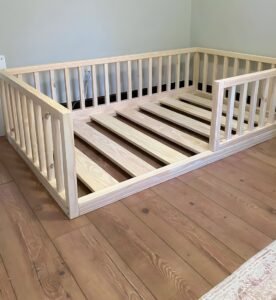
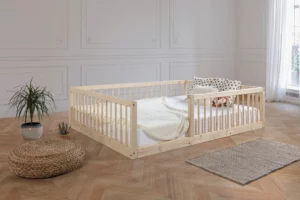
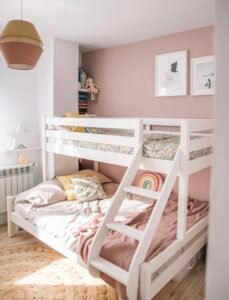
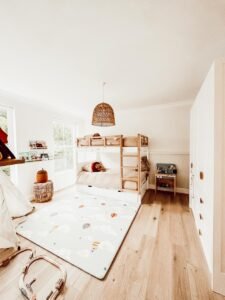
A well-designed shared bedroom is genuinely lovely. Two siblings sharing a room can build a stronger bond, the room itself feels more lived-in and warm, and the parents reclaim a guest room or a study. But getting there takes more than two beds pushed against opposite walls. It takes a layout that gives each child a sense of their own space inside the shared one.
Here’s how to design a shared kids bedroom that works for both children and looks calm doing it.
The first decision: bunks or twin beds?
Almost every shared kids bedroom comes down to this. Both options have a place; the right one depends on the room, the ages of the children, and how often they have friends over.
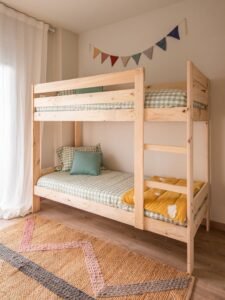
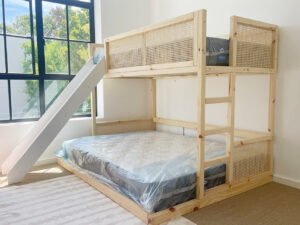
Bunks save floor space dramatically. A bunk bed takes the floor area of one bed and gives you two sleeping spots. The freed-up space transforms small rooms, there’s suddenly room for a play area, a desk, or just more clear floor.
The trade-off: less individual privacy. The two beds are stacked, which means one child sees the other’s underside of the mattress at bedtime. Some sibling pairs love this; others find it oppressive.
Twin beds, two separate singles, give each child a more defined personal area. The visual separation is real, and the room reads more like “two kids share this room” than “two kids stack in this room”. Sleepovers also flow better with twin beds; there’s no awkward upper-bunk negotiation.
The trade-off: floor space. Two singles take roughly twice the area of a bunk. In a room under 12m², this gets tight quickly.
Our guide on bunks vs single beds digs into the comparison in detail, but as a quick rule:
- Room under 12m² → bunk
- Room 12–15m² → either works; twin beds if both kids are over six
- Room 15m²+ → twin beds, almost always
Define personal space within the shared room
The single most important design move in a shared bedroom is giving each child a piece of space that’s clearly theirs. Without this, every disagreement becomes territorial, whose toys are spreading onto whose half, whose books are taking over the shelf.
The simplest ways to define personal space:
- A different coloured wall behind each bed (or wallpapered panel)
- One bedside table per child, in matching style but not identical
- A personal shelf for each child’s books and treasures
- A drawer or basket each in a shared toy or clothing storage piece
- A nameplate or photo above each bed
The goal isn’t equality of square metres, it’s clarity. Each child should be able to point and say “that’s mine”.
Layouts that work
A few layout patterns we’ve seen succeed in shared rooms.
Bunks against one wall, everything else along the other. Works in narrow rooms. Bunks take one long wall; the opposite wall has a shared desk, storage and play area.
Twin beds against opposite walls, headboards facing in. Classic and calm. A rug or play space sits between them. A shared piece of storage at the foot of one bed or against the third wall.
Bunks plus a single trundle below. Three sleeping spots in the floor space of two, useful for households where a third sibling or a regular cousin makes the room flexible.
L-shaped twin layout. Two beds at right angles in a corner, sharing a corner shelf. Particularly good for siblings of different ages who want some visual separation but appreciate being able to chat across the gap.
A house bed and a daybed combo. Two distinct sleeping styles, a house bed for one child, a daybed for the other, gives each their own character within the same room. Visually charming, and great for siblings of clearly different ages.
Storage that doesn’t fight
Shared rooms generate twice the toy load and twice the clothing load of single-occupancy rooms, in the same space. Storage has to work harder.
A few principles that hold up:
- Shared storage for shared toys, personal storage for personal things. Lego is shared; a special doll is personal. The categories matter.
- Use vertical storage. Tall, narrow shelving stores more in the same footprint than wide, low pieces. Browse our shelves and storage range for pieces designed this way.
- Closed storage at low level for younger children. A bench-style toy box doubles as seating and hides the visual clutter at toddler height.
- Open shelves above for older children. They reward the more disciplined kid and become a quiet display surface.
- One large shared basket beats four small ones. Counter-intuitive, but easier to maintain.
A bookshelf at the foot of a bed, dividing the room slightly, can also create a soft visual boundary between the two halves without taking up extra space.
Age-gap considerations
A shared room of two five-year-olds is a different design challenge to a shared room of a four-year-old and a ten-year-old. With a significant age gap, you’re balancing two sets of needs in one space.
A few adjustments:
- Bedtimes are staggered, give the younger child a low light at their bed, and the older child a reading light away from the sleeping space.
- The older child needs a desk, even a small one. The younger one doesn’t.
- Toys vs books. The older child’s books shouldn’t be at the younger child’s level (where they’ll be torn). The younger child’s toys shouldn’t be on a shared shelf (where they’ll take over).
- Personal space is more important with an age gap. A privacy curtain on the lower bunk, or a tall headboard on a twin bed, lets the older child retreat without leaving the room.
Sound, light and the quiet wins
A shared bedroom is most likely to fail at bedtime: one child reads while the other tries to sleep, one wakes early and disturbs the other.
A few quiet design wins:
- Two separate reading lights rather than one shared overhead light at bedtime
- Bunks with a top-bunk light niche so the upper bunk can read without lighting the bottom bunk
- A small fan or white-noise machine to mask one child’s movement from the other
- Heavy curtains that hold light well in shared rooms with early risers
- A clock with a gentle morning glow for the older child, so they know whether to stay quiet or get up
A shared room that grows with both children
The best shared rooms are designed to flex as the children grow. Twin beds that started 50cm apart can move further apart as the children get taller. A bunk can become a single bed with a high shelf when the younger sibling moves into their own room. A shared desk for two primary-school children can become a single teen’s desk five years later.
Choose pieces that survive change, solid wood beds, a classic kids bed or a well-built bunk, hold up for a decade or more and adapt as the room’s purpose shifts.
Browse pieces made for shared rooms
Have a look at our bunk bed collection, our classic kids beds (which work beautifully as twin pairs), and our full beds collection. Most pieces are sized and finished to pair cleanly in a shared room.