Buying a kids bed feels like it should be simple. Pick a size, pick a style, place the order. In practice, it’s one of the more drawn-out decisions in setting up a child’s bedroom, partly because the bed is the most expensive piece, partly because it’ll be in the room for years.
Here’s a complete guide to the decision, drawing on what we’ve learned making beds for South African families over the years.
Start with how long you want the bed to last
The single most useful framing question. Are you buying a transitional bed that’ll last until the child is six? Or are you investing in a piece that’ll see them through to high school and beyond?
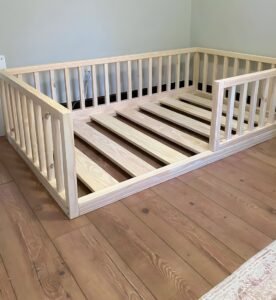
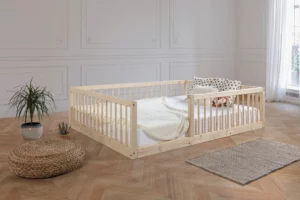
Transitional (3–5 years): A house bed, a low cot-conversion, or a Montessori-style floor bed. These pieces nail the early years and create the right environment for an independent sleeper. They typically get replaced around age six.
Long-haul (7–12+ years): A classic kids bed in single or three-quarter, made from solid wood. These are the beds that end up in second bedrooms and guest rooms after the child has outgrown them. They hold up for decades.
Forever-ish (15+ years): A solid three-quarter or double bed in a timeless style. Pair with a quality mattress and good linens and the same bed can move with the child from primary school through to university residence.
The longer the horizon, the more it makes sense to spend properly on materials and construction. A R6,000 bed that lasts 15 years works out to R400 per year. A R2,500 bed that needs replacing in three years costs more than that.
Size: The Practical Reality
South African kids bed sizing is straightforward. The two everyday sizes are the single (92 × 188cm) and the three-quarter (107 × 188cm). The decision usually comes down to room size, the child’s age, and how long you want the bed to last.
A rough framework:
- Age 3–6 in a small room → single
- Age 6–12 in a normal room → three-quarter (most versatile for the long haul)
- Age 12+ or a generous room → three-quarter or double
- Two children sharing → bunk beds, or two singles
For the full sizing detail with mattress dimensions and room-fit rules, see our kids bed sizes guide.
Style: Five Honest Archetypes
There are dozens of bed styles, but they collapse into five archetypes for kids’ rooms.
- House beds. A wooden frame in the shape of a house or pitched roof, sometimes with a roof, sometimes just the silhouette. Creates a defined sleeping nook that children love. Excellent for ages 3–8; some designs continue to suit older children. Available across our house bed collection.
- Classic singles and three-quarters. A traditional bed shape, headboard, side rails, slatted base. The most flexible long-term choice. Works in any room style, suits any age from three upwards. See our classic kids beds.
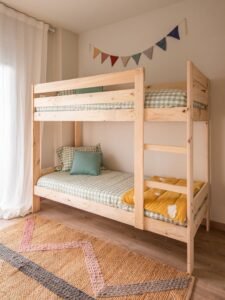
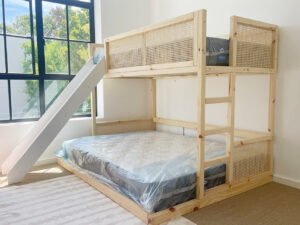
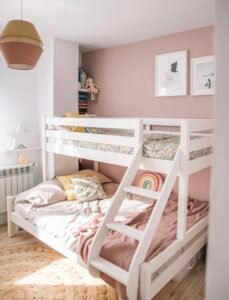
- Bunk beds. Two beds stacked. Saves dramatic amounts of floor space in shared rooms, but the top bunk is only suitable from age six. Read our bunk bed safety guide before ordering.
- Daybeds and Montessori floor beds. Low-profile beds at or near floor level. Daybeds double as occasional seating; Montessori floor beds support early-childhood independence. Excellent for ages 18 months to 5 years.
- Loft and storage beds. A raised bed with desk, storage or a play area underneath. Great for older children in small rooms, but plan for the ceiling height (minimum 2.4m clear) and the climb in and out.
If you’re caught between two styles, the question usually answers itself once you commit to a length-of-use horizon. House beds are wonderful but rarely make sense for a 12-year-old. A classic single in solid Pine or Oak makes sense for almost any age.
Materials: Why Solid Wood Matters
For something a child will sleep on every night for years, the materials matter more than they would in adult furniture.
Solid wood (Pine, Ash, Oak, Supawood). The right choice for kids beds. Solid wood absorbs the bumps of childhood without splitting, holds screws and bolts under repeated tightening, and develops character rather than wear. Heavier than alternatives, which means more stable.
Engineered wood / MDF. Cheaper, lighter, and acceptable for short-term use. The trade-off is durability: MDF doesn’t tolerate repeated assembly-disassembly well, holds screws less reliably, and can release particles if the surface is damaged.
Metal frames. Long-lasting but cold and harder to repair. Welds can fail; tube frames can dent. Often noisy under restless sleepers.
Particleboard. Avoid for kids beds. Doesn’t survive the rigors of childhood sleep.
Our beds are made from carefully selected SA Pine, Supawood, Ash and Oak, sourced sustainably and chosen for strength, finish, and the way each timber takes paint or stain.
Finishes: The Safety Conversation
Anything that goes in a child’s room should be finished with a non-toxic, low-VOC coating. The standard worth looking for is child-safe PU paint with international certification. These coatings have been tested for safety even when chewed (a real possibility for younger children).
Our finishes use premium child-safe PU paint with international safety certification. The practical benefits beyond safety:
- Easier cleaning, accidents wipe off rather than soak in
- Resistance to scuffs from headboards meeting walls
- A finish that wears well rather than flaking off
- A consistent look across the bed and matching pieces
Avoid: high-VOC lacquers (you’ll smell them for weeks), unstated “kid-safe” claims without certification details, and unsealed bare wood in a child’s room (it absorbs moisture and splinters).
The base, and a quick word on mattresses
The bed-base-mattress combination is what your child actually sleeps on, so the base spec matters as much as the frame.
- Slatted base. A bed with a solid slatted base supports the mattress evenly and extends its life. Slats spaced 5–7cm apart are ideal.
- Mattress thickness matters for safety. Match the bed’s recommended thickness, too thin and the base is uncomfortable, too thick (especially on a top bunk) creates a real safety issue with guardrail height.
On the mattress itself: most parents source it separately, and that’s the sensible approach. Mattress preferences vary widely (firmness, materials, budget), and there’s no single right answer. We focus on building beds that pair well with any quality South African mattress in the standard sizes, and we’re happy to confirm the recommended thickness for any specific bed if you ask.
The build-quality checklist
A well-made kids bed should:
- Use through-bolts at joints, not just nails or staples
- Have slats fixed to the side rails, not just dropped in
- Use solid timber for structural parts, not engineered wood
- Have rounded or eased edges at any height a child might bump
- Carry a clear warranty from the manufacturer
- Be available in standard SA mattress sizes without needing custom mattresses
If any of these are vague in the product description, ask. A trustworthy maker will answer specifically.
Lead times and what to expect
A good kids bed is rarely off-the-shelf. Most solid-wood beds in South Africa are built to order in workshops, which means lead times of 4–8 weeks depending on the maker and the time of year. Plan accordingly:
- Order at least 6 weeks before you need the bed in place
- Confirm lead time at the time of order, not later
- Build in delivery time on top of manufacturing, particularly for Joburg, Durban or Pretoria deliveries from a Cape Town workshop
- Order your mattress in parallel. Most parents buy the mattress separately, so check that supplier’s lead time too and aim to have both arrive close together
We confirm lead times at the time of order, so you know exactly when your piece will arrive.
A short framework for the final decision
If you’re stuck, here’s how we’d guide a typical decision:
- How long is this bed for? Transitional, long-haul, or forever-ish.
- What style fits the room and the child? House bed, classic, bunk, daybed, or loft.
- What size makes sense? Single, three-quarter, double, or a bunk pair.
- What’s the budget that survives 5–10 years of use?
- Solid wood, child-safe finish, slatted base. Non-negotiables.
Once those five questions are clear, the choice between specific beds becomes much easier.
Where to start browsing
Our full kids beds collection covers every style, size and finish we offer, or have a look at Shop All Kids Beds for a single ungrouped view. If you’d like guidance on a specific room or a custom size, drop us a message, we’re happy to help with sizing, finishes and the right pieces for your home.