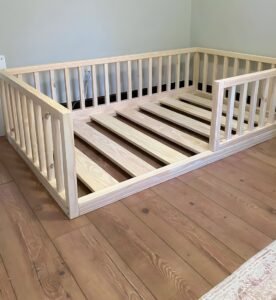
Moving out of the cot is one of the bigger transitions in a young child’s bedroom life. A Montessori floor bed is one of the most popular destinations for that move, and for good reason: it is low, accessible, and gives the child immediate independence over their sleep. But the transition itself takes a little preparation to go smoothly.
This guide covers how to time the move, how to get the room ready, what to expect in the first two weeks and what to do if things go backwards before they go forwards.
Signs your child is ready
Age is a starting point, not a rule. Our piece on moving from a cot to a bed goes into the timing in more detail. The signs that matter most when considering a floor bed specifically:
- Your child is attempting to climb out of the cot. A child who can get themselves out anyway is already past the point where the cot is doing its job.
- They can follow a basic instruction. ‘Stay in bed until morning’ or ‘wait until the light comes on’ needs to be within their developmental reach.
- They are sleeping relatively consistently. A floor bed is not a solution to poor sleep; it can make it harder. If your child still wakes multiple times a night and needs adult input to resettle, it may be worth addressing the sleep pattern first.
- They show interest in independence. A child who wants to do things themselves, who resists being lifted or helped, is a strong candidate for a floor bed.
When to make the move
The 18-month to 3-year window is when most South African families make this transition. Within that window, there are better and worse moments:
- Avoid major life disruptions: a new sibling arriving, a house move, starting creche for the first time. Bed transitions go more smoothly when the rest of life is stable.
- Avoid illness: a sick child needs familiarity. Wait until they are well before changing the sleep setup.
- Consider the season: a winter transition in Johannesburg or Pretoria means a cold floor. Make sure you have a rug in place and a sleeping bag rated to the temperature before you start.
- Use a quiet period: a school holiday, a week with no travel, a stretch of normal routine. The first two weeks are when you need consistency the most.
Preparing the room before night one
Do not make the transition until the room is ready. Room-proofing is the most important step, and it needs to happen before the first night, not after the first escape.
The full safety checklist is in our Montessori floor bed safety guide. The short version:
- Cover all electrical sockets.
- Anchor any freestanding furniture to the wall.
- Clear cords, blind pulls and small objects from the floor.
- Put a rug down around the bed for warmth and a soft landing zone.
- Decide whether the room door will be closed or open at night. If open, ensure the rest of the house is safe for unsupervised wandering.
Once the room is proofed, set up the floor bed against one or two walls. Place the mattress so the child has a clear exit on at least one side. Keep the area immediately around the bed clear.
The transition itself: gradual or all at once?
There are two schools of thought, and both work. Choose based on your child and your own preferences.
The gradual approach
Start by lowering the cot mattress to floor level if your cot allows it. Or place the floor mattress in the room alongside the cot for a week, letting the child explore it during the day. When you are ready, move their sleep to the floor bed while keeping the cot in the room briefly as a familiar object. Remove the cot after a week or two.
The all-at-once approach
Remove the cot, set up the floor bed, and simply start. Many families find this cleaner: there is no confusion about which bed is for sleeping, and the child adapts faster when there is only one option. If your child is confident and adaptable, this is usually fine.
One thing that helps with either approach: involve the child in the setup. Let them help put the sheets on, choose where a soft toy goes, pick the pillow. Ownership of the space is part of the Montessori principle and it genuinely helps with buy-in at bedtime.
What to expect in the first two weeks
Be honest with yourself before you start: the first week or two is often harder before it is easier. Common patterns:
- Night one: often goes surprisingly well. The novelty factor works in your favour.
- Days 3 to 7: the harder stretch. The novelty has worn off and the child has worked out that they can get out. Expect early exits, a few middle-of-the-night appearances and some bedtime stalling.
- Week two: most families report things settling into a rhythm. The child learns the expectation; the exits become less frequent.
Consistency is the key variable. Every time you respond the same way, gently but firmly returning the child to bed with minimal engagement, you reinforce the expectation. Inconsistency at night is the biggest predictor of a rough first month.
Some families use a toddler clock or a light-up alarm that tells the child when it is okay to get up. This works well alongside a floor bed and removes the ambiguity that drives early exits.
Managing regressions
A regression after a successful transition is normal and does not mean the floor bed has failed. Common triggers: illness, a new sibling, a change in routine, a developmental leap. The response is the same as the initial transition: calm, consistent, minimal engagement at night.
If a regression runs for more than two to three weeks without improvement, it is worth looking at the broader sleep picture rather than the bed itself. The floor bed is rarely the cause of a persistent problem; it more often reveals one that was already there.
What comes after the floor bed
Most children move from a floor bed to a standard-height kids bed somewhere between 4 and 6 years. If you bought a house-frame floor bed, many of our designs can be raised onto a standard frame, extending the life of the piece. Have a look at our house bed collection to see which styles work this way, or get in touch and we will talk through the options.
If it is time for a fully raised bed, our classic kids bed range is the natural next step. And if you are starting from the beginning with a new baby, our nursery range covers the cot and compactum options we build in our Cape Town workshop.